Bijay Basukala
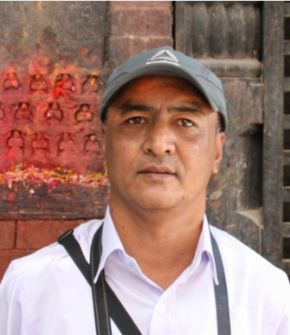
- Profession: Architect and Architectural Documentarian
- Country of Origin: Nepal
- Date of Birth: 1965
Bijay Basukala (born 1965, Byasi, Bhaktapur, Nepal) is a trained architect, draftsman, and artist with over forty years of experience as a specialist in architectural documentation and heritage conservation. He is widely recognized as one of Nepal’s prominent experts in Nepal when it comes to the measured documentation and restoration of traditional Newar architecture, particularly within the Kathmandu Valley.
Basukala studied architecture at the Pulchowk Institute of Engineering and graduated in 1986 with a Proficiency Certificate Level (equivalent to today’s diploma). While still a student, he started working on monument documentation as early as 1984 through a scholarship from the Bhaktapur Development Project, where he started learning directly from historic buildings themselves – measuring, drawing, surveying, and observing traditional construction methods on site. This early hands-on experience shaped his entire career and fixed his path toward heritage documentation and restoration.
From 1987 onward, Bijay Basukala began collaborating with Prof. Dr. Niels Gutschow, the renowned German architect and scholar known for his research on South Asian and Newar architecture. Together, they documented and studied many temples, monasteries, phalchas, and historic structures in the Kathmandu Valley. Their collaboration played an important role in recording and understanding traditional Newar architecture at a time when much of it had not yet been systematically documented.
Within Nepal’s architectural and heritage conservation community, Basukala is known as someone whose understanding of architecture is not merely technical but also intuitive and artistic. His hand-measured drawings are valued for their accuracy as well as their sensitivity to proportion, detail, and form. Indeed, many consider him one of the most reliable and skilled experts in architectural documentation, particularly for Newar monuments.
Throughout his career, he has worked on a wide range of national built-heritage conservation and restoration projects. These include the documentation of Boudhanath Stupa (1990) and restoration of Vabaha, Patan (1993-1998), documentation of Godavari Chorten Tongdrol Chenmo (1999), Godavari Chorten Tseltse Donden (2004), Itumbaha (2003), and restoration of Keshav Narayan Chowk, Patan (1990). He was also involved in documenting the hiti(s) of Patan Durbar Square, namely Manga Hiti, Sundhara, and Bhimsen Hiti.
Basukala was a key artist at the Kathmandu Valley Preservation Trust (an organization that was founded in 1990 to protect the threatened architectural and urban heritage of the Kathmandu Valley), where he prepared detailed drawings that aided in the restoration projects, such as Kulimha Narayana Temple in Patan and Itumbaha in Kathmandu.
His expertise also extended beyond Nepal. He contributed to architectural surveys of the Preah Ko temple complex in Cambodia in 1996, the Erdene Zuu monastery complex in Mongolia in 2003, and heritage documentation projects in Puri, Odisha, during 1998 and 1999. These experiences further strengthened his understanding of traditional architecture across different cultural contexts.
He has also co-authored books “Patan-Vabaha: History and Inventory of a Newar Buddhist Monastery” and “Towers in Stone Sikhara Temples in Bhaktapur–Vatsala and Siddhilaksmi” alongside Niels Gutschow. In addition to these publications, many of his scaled hand-drawn drawings such as Toran of Krishna Temple, Bhaktapur are well preserved at Nepal Architecture Archive (NAA), in Boudha.
In 2015, he led the rebuilding of the Harishankara Temple in Patan Durbar Square through KVPT, which collapsed during the earthquake. During the restoration of the Mani Mandap, he also prepared a full-size drawing of one of its pillars to guide the carving process. In 2018, he began leading extensive heritage documentation work across the Kathmandu Valley in collaboration with the Nepal Heritage Documentation Project (NHDP), focusing mainly on precise hand-measured drawings. The documentation work continues to the present day.
Basukala is one of the few people in Nepal who deeply understands how traditional Newar architecture responds to earthquakes and how it can be strengthened without changing its appearance or authenticity. Today, his drawings and documentation are regarded as an important record of Nepal’s architectural heritage. Basukala’s quiet, patient work has made authentic restoration possible, and his contributions will continue to guide future generations of architects and heritage enthusiasts.
Patan, Bhaktapur, Kathmandu, Boudha, Mustang, Mugu, Cambodia, Mongolia, India (Odissa), India (Vanarasi)
Kathmandu Valley Preservation Trust (1999-2001), Architectural Survey- Mustang, Khyinga, Architectural Survey-Mustang Villages of Te & Kag, Bhaktapur Kadam Chorten at Tahaja, Bhaktapur Vatsala Temple Siddhilaksmi Temple (2013), Boudha Caitya, Elevation North and Top View (1990), Buddhist Kathmandu, Cabahil Caitya, Caitya at Daubahanani, Caitya Sketches (1990-92), Caitya Survey (1989-1993), Caitya Survey (1987-1988),Chorten Tongdrol Chenmo (1999), Chorten Tseltse Donden (2002-2003), Dirk Naumann Stupa (2002), German Research Council – Nepal Research Programme (1980-1987), Godavari Chorten Tongdrol Chenmo, Godavari Chorten Tseltse Donden, Gutschow House (2000-2003), Itumbaha Initiative (2002), Jeetjung- Prakaseswor Sattal (2006-2015), Kathmandu Hyatt Hotel- Chaitya Court, Kathmandu Kalabhairava (elevation 1:10), Kathmandu Valley Preservation Trust (1999-2001), Keshav Narayan Cok, Khyinga, Krishna Temple, MUGU – KIMRI (September 1998), Nepal-German High Mountain Archaeology Project (1991-1999), Patan Conservation and Development Project (1990-1995), Patan Mahaboudha Temple, Pencil drawings, Sumerucaitya, Taleju, Kathmandu (2004), Thulku Oser (2002), Varanasi Research Project (2000-2001), Yetkhabaha, Ikhalakhu Jadu, Mugu (1998), Restoration of Vabaha, Sundhara, Manga hiti, Bhimsen hiti, The Nepalese Caitya (1987-1999)
- “Towers in Stone: Shikhara Temples in Bhaktapur, Vatsala and Siddhilaksmi”. Bijay Basukala, Niels Gutschow, Kishor Kayastha. Himal Books, 2014.
- “Patan-Vabaha: History and Inventory of a Newar Buddhist Monastery”. Bijay Basukala, Niels Gutschow, Nutandhar Sharma. Rich Publishers, 2022.